From the “$0 to $1B Club” to AI x crypto and infrastructure bets, top investors from Sequoia, Snowflake, and others share where they see real adoption, returns, and disruption in 2026.
As AI enters 2026 with a shift from promise to proof, the pressure is on to show real adoption, real economics, and real infrastructure that can support the scale of what’s ahead. The conversation is moving beyond model breakthroughs toward productivity gains, workflow integration, and the hard constraints of compute, energy, and data.
In this environment, capital access will be more selective, with investors rewarding teams that can deliver measurable outcomes, manage costs, and build defensible positions in an increasingly competitive market.
To understand how this landscape could evolve, here’s how leading investors and operators expect the AI and data markets to take shape in the year ahead.
1. Infrastructure will slow as adoption surges
My prediction for 2026 is that it will be a tale of two AIs. On the one hand, it will be a year of delays, first in data center buildouts, many of which will fall behind schedule, and second, in the AGI timeline. At the same time, AI adoption will continue its relentless rise. In 2025, startups coined the idea of a “$0 to $100M” club of rapidly scaling AI companies; in 2026, we’ll begin to talk about the “$0 to $1B” club.
Entering 2026, here are the facts as I see them:
- Demand for AI CapEx from the Big Tech companies is stronger than ever.
- Google and Meta are fully betting the farm on AI.
- While Microsoft and Amazon pulled back slightly in 2025 relative to peers, both continue to aggressively position themselves for the AI future.
- Supply chain players seem weary: The customer’s customer is not as healthy as they’d wish. They are worried about being left holding the bag.
- The end revenue from AI remains limited (on the order of tens of billions per year) relative to the scale of data center and energy investments (on the order of trillions over the coming five years).
- There are two killer apps in AI: coding and ChatGPT. Both are expected to approach or cross double-digit billions of revenue this year. Nearly a dozen more startups are on the path to cross $100M+ in the near future, across a wide variety of applications
- Big enterprises are struggling to implement AI in-house, which is leading to fatigue and disappointment.
— David Cahn, Partner at Sequoia Capital
2. AI enablers and solutions will split into two races
In 2026, we’ll see a clear separation between AI enablers — the infrastructure and tooling powering model development — and AI-enabled solutions that use AI to solve deep, domain-specific business problems. The winners will be those who combine incumbent domain expertise with AI-native technical leadership, delivering purpose-built workflow automation that drives measurable business outcomes.
The era of experimentation will give way to one of fit-for-purpose adoption and enterprise integration, where AI quietly becomes the operating layer for how work gets done.
— Harsha Kapre, Head of Snowflake Ventures
3. AI–crypto–deep tech will produce the next giants
The most important companies of this next cycle will be built at the intersection of AI, crypto, and deep tech, using decentralized networks to verify data, route workloads, and settle value in real time, anchored by resilient and secure infrastructure. Limited partners will re-engage with venture as rates ease and inflation normalizes, but capital will consolidate around managers with operating depth, real exits, and exposure to durable themes like AI, defense tech, and energy transition. Undifferentiated funds will find fundraising materially harder.
AI will need to prove itself in the numbers. The next phase of returns will come from companies that can show measurable productivity and margin improvement in sectors like logistics, manufacturing, and services, not from abstractions or feature-level AI stories.
Crypto will increasingly function as financial infrastructure. Stablecoins, tokenized real-world assets, and compliant, auditable rails will attract serious institutional use, while low-utility speculative tokens matter less to where meaningful capital flows.
— Anthony Georgiades, Founder & General Partner at Innovating Capital
4. AI will become the operating layer of work
By 2026, we expect AI to move from experimentation to deep integration — quietly embedding itself into industry workflows, data infrastructure, and consumer experiences. The next wave of opportunities won’t just be about building smarter models but enabling them to operate efficiently, securely, and contextually at scale. Edge AI, privacy-first data infrastructure, and AI observability tools will see significant tailwinds as enterprises demand control, cost efficiency, and compliance.
On the consumer side, we see massive potential in AI-native products that personalize experiences, from commerce to finance to wellness, leveraging proprietary data and trust as key differentiators. Infrastructure layers that simplify fine-tuning, deployment, and governance of models across hybrid environments will become the new picks and shovels.
Next big opportunities will be agentic shopping and commerce, disrupting a $5T+ retail market; companionship and social apps combating loneliness; content creation and entertainment for personalized content/education/play; and embodied AI devices, from glasses to robots, for context-aware help.
For investors, the winning companies will be those that solve ‘infrastructure pain’ in the AI value chain rather than chase the next model trend. At TDV Partners, we believe the future of AI lies in enabling intelligence to work seamlessly within existing systems, quietly transforming them from the inside out.
— Ujwal Sataria, Founder and General Partner at TDV Partners
5. Healthcare will emerge as AI’s biggest unlock
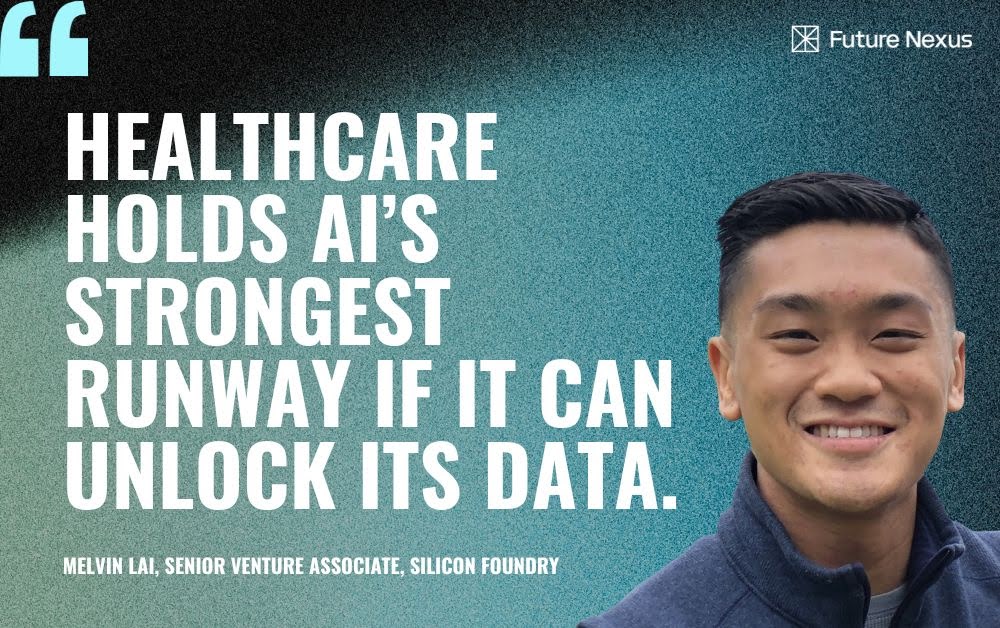
Healthcare holds AI’s strongest runway if it can unlock its data. As many industries face data exhaustion and AI model plateaus, healthcare remains uniquely advantaged, sitting atop decades of untapped clinical notes, medical records, and real-world evidence. The future isn’t just building new models; it’s responsibly unlocking and structuring the knowledge already in the system.
At the same time, expect a meaningful uptick in healthcare M&A, not for financial engineering, but as the fastest path to scale, workflow integration, and data access in a sector where selling into systems can take years.
— Melvin Lai, Senior Venture Associate, Silicon Foundry
6. Data will become the defining moat
We’re moving from “model abundance” to data authority—the real moat is no longer the model, but who controls clean, fast, compliant data pipelines. Founders who treat data like an operating system instead of a reporting tool will break away from the pack.
We’ll also see AI move from copilots to autonomous workflows. Instead of assisting tasks, AI will own entire processes end-to-end—trigger, execute, resolve, and only escalate when necessary. This is where enterprise budgets shift: from experimentation to actual workflow replacement, especially in ops, compliance, analytics, and back-office functions.
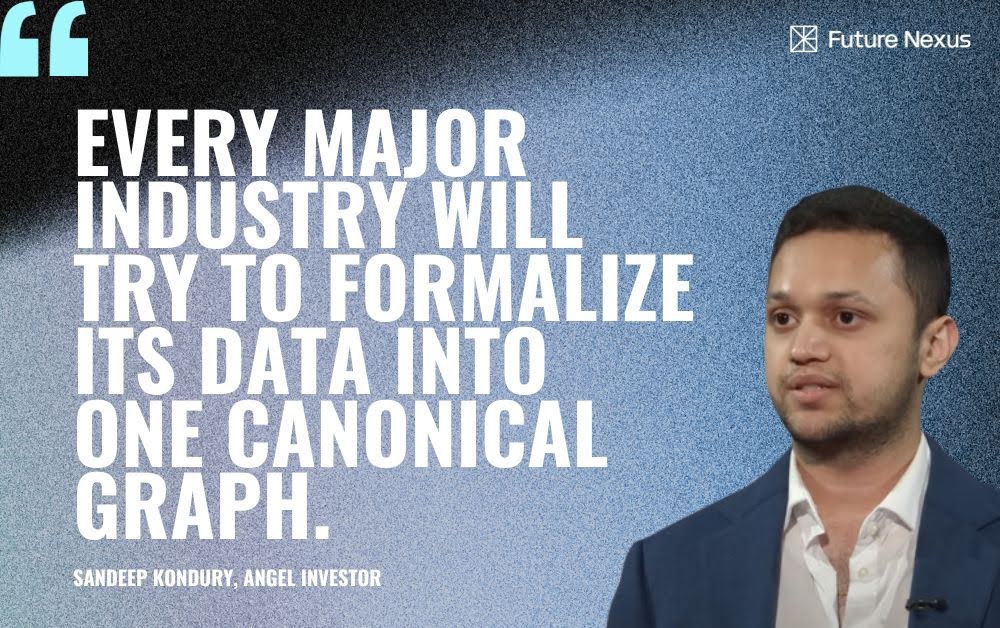
Finally, I see a big shift toward vertical knowledge graphs and conversation-based market signals. Every major industry will try to formalize its data into one canonical graph, and the markets with the highest conversation density—internally, socially, and operationally—will correlate most closely with actual willingness to spend.
2026 belongs to teams who treat data as infrastructure and AI as a decision engine, not a feature.
— Sandeep Kondury, Angel Investor
7. Defense and energy will become major AI investment zones
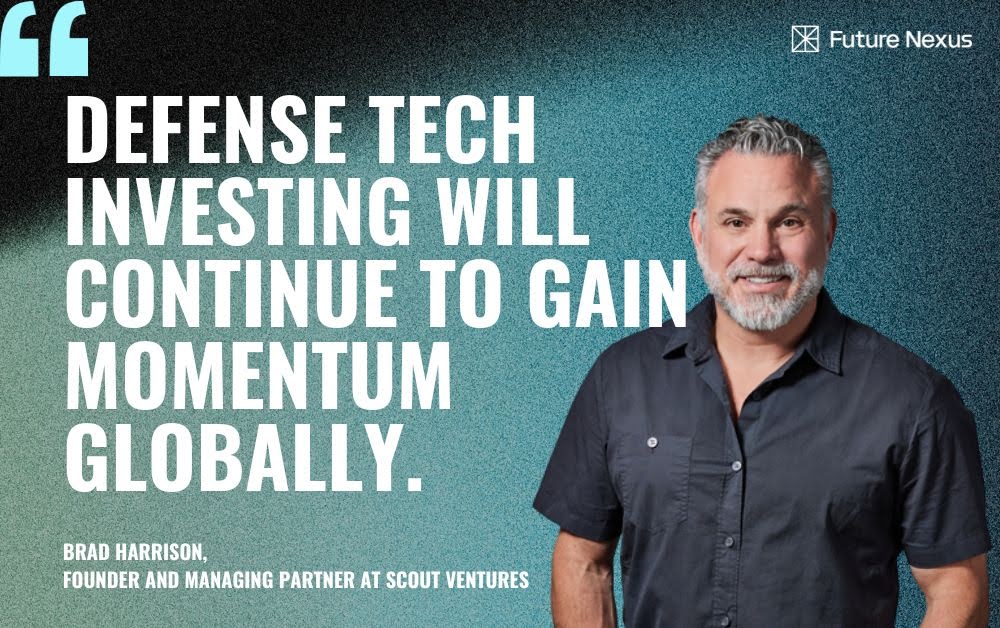
Defense tech investing will continue to gain momentum globally… Domestically, we’ll see whether the Pentagon’s overhaul of its acquisition process translates into programs of record for emerging defense startups. The AI and humanoid robotics trend will persist, though AI companies will face increasing pressure to control capital expenditures and demonstrate a viable path to profitability.
I expect continued investment in alternative energy startups, particularly around nuclear and Casimir cavity technologies. Power generation remains critical, both to support the massive energy demands of data centers and to enable autonomous systems, especially as defense applications scale globally.
Beyond energy, there are significant opportunities in supply chain innovation, specifically around batteries, motors, and sensors. China’s current dominance in these areas represents a critical challenge for the emerging defense ecosystem, particularly given their threat to annex Taiwan by 2028 and the resulting Indo-Pacific military buildup. This creates both strategic vulnerability and substantial commercial opportunity for companies that can develop domestic alternatives and support allied nations’ defense modernization efforts.
— Brad Harrison, Founder and Managing Partner at Scout Ventures

8. Contextual AI search will reshape discovery
Contextually understanding the data and ensuring that the data is accurate, up-to-date, and timely will be important in pushing the boundaries of AI. As you get better, more timely data will enable AI models to provide more insightful real-time feedback, which is one of the advantages of The Intelligent Search Company, one of the latest companies in our portfolio.
Search results right now can’t interpret the context and background of a person. Think of the search results on Amazon, which are polluted by all of your past searches. Or Spotify/YouTube — if you have a family member use it, your recommendations won’t be of interest to you. AI will start understanding the context and nuance of your searches going forward, leading to better matches. In the future, the top link will matter much more than the next 9. And this will have a large impact on marketing and marketplaces.
— Alex Norman, Managing Partner of N49P, an early-stage Canadian Venture Fund
9. 2026 will be a breakout year for quantum
Startups don’t want cash cows; they want catalysts. In 2026, AI startups will realize capital alone isn’t enough—Corporate Venture Capital will become a must-have in their cap tables to scale. Partners who provide new opportunities, including access to valuable networks, customer ecosystems, and clear pathways to scale will offer the most value in the long term. Because of this, startups will seek catalysts who can support them through an incredibly competitive landscape, integrate into enterprise workflows, and unlock market potential.
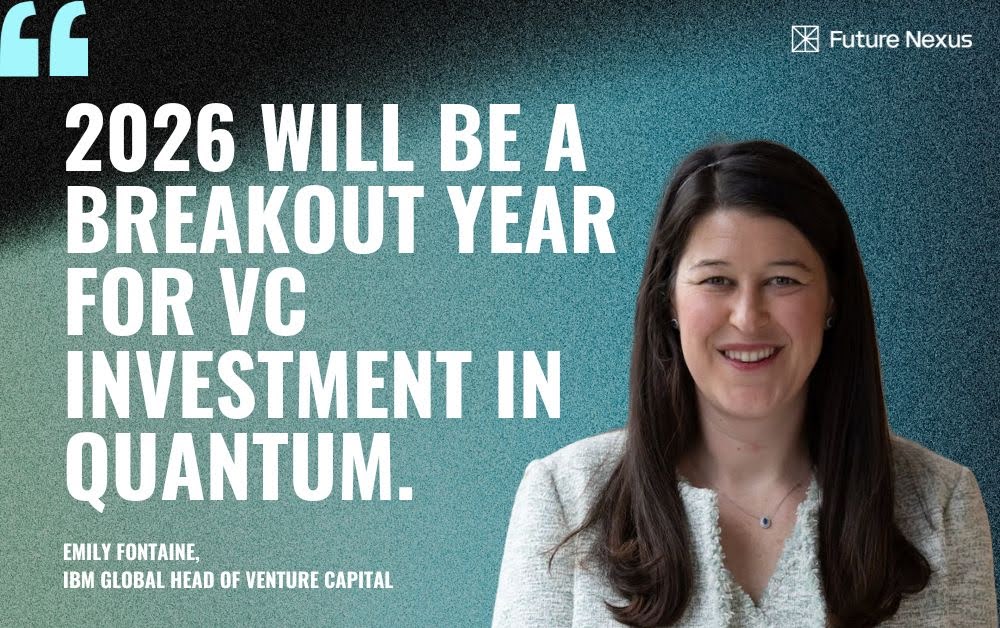
2026 will also be a breakout year for VC investment in quantum. Quantum technology is on the path to solve real-world challenges that could be out of reach for AI or classical computing. As quantum becomes increasingly powerful on the track to quantum advantage, the technology will become more interesting for investors as organizations leverage it to tackle inefficiencies and unlock new use cases. Yet quantum remains such an emerging and highly specialized field that most traditional VCs don’t know where to start— how should these startups be valued, which companies are actually moving the needle, what metrics and technical milestones are important, or even which problems can be solved through quantum.
Making the right bets now will lay the foundation for a robust global quantum ecosystem in the not-so-distant future.
— Emily Fontaine, IBM Global Head of Venture Capital
10. Capital will concentrate selectively
The VC opportunity set is bifurcated, with strong (often AI-driven) companies attracting capital while all others struggle. It’s no secret that AI startups are commanding significantly higher valuations and round sizes across all stages. The US led this trend, accounting for 85% of global AI funding and 53% of AI deals. It’s not just the home of the financing either: Four of the seven largest AI rounds were US-based.
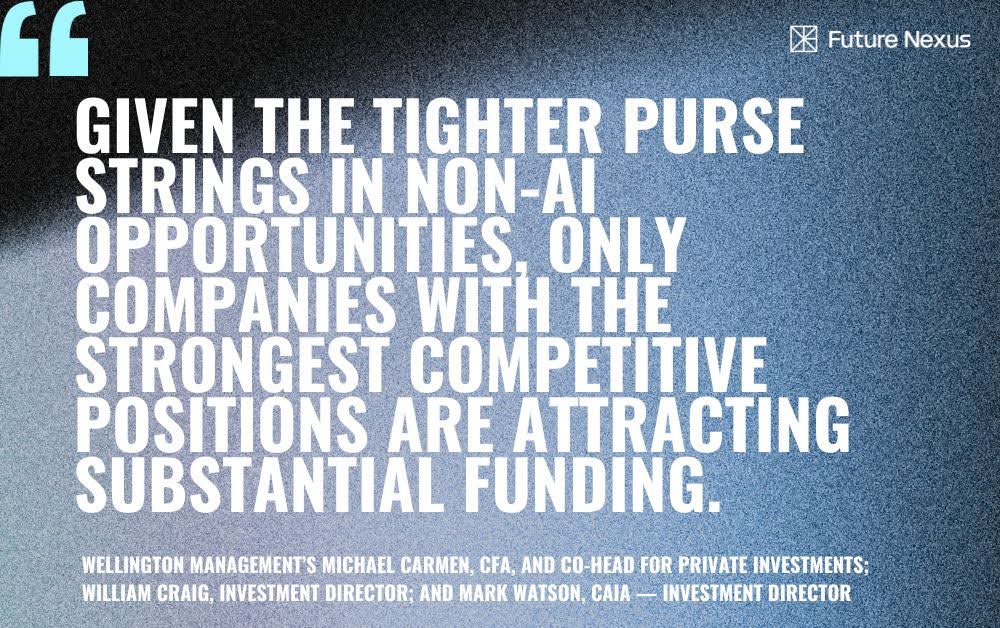
Critically, this hyperfocus on AI has had widespread impacts on fundraising for other sectors. Given the tighter purse strings in non-AI opportunities, only companies with the strongest competitive positions are attracting substantial funding. Investors are prioritizing companies with strong unit economics, growth, and defensible market positions. As concentration in top-tier assets persists, we believe 2026 will continue to reward selectivity and conviction.
— Wellington Management’s Michael Carmen, CFA, and Co-Head for Private Investments; William Craig, Investment Director; and Mark Watson, CAIA — Investment Director