The creator behind Yeti Boo didn’t set out to build an AI content studio. He just wanted to see whether a shaggy, AI-generated hyper-realistic Bigfoot with a laid-back, outdoorsy personality could work as a TikTok bit.
After a few days and 130,000 followers, it was clear the joke had (rather hairy) legs — and brands like Igloo Coolers and KANE Footwear noticed. (The Yeti Boo account currently has more than 439,000 followers.)
Yeti Boo’s creator, who prefers not to use his name because he has a separate full-time job unrelated to content creation, has since turned the character into the centerpiece of a growing AI content studio called DreamCell AI, which grew out of Yeti Boo’s popularity and now produces AI-driven social videos and other content for brands.
His experiments tap into a familiar tension for marketers: how to get the organic feel of creator content without losing control. But, in this case, there’s a twist, because the “creator” is an AI mascot that brands can hire like any other partner.
An AI Athlete
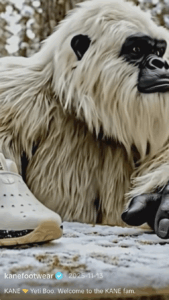
When KANE Footwear was planning the launch of its Revive AC, a more rugged version of its recovery shoe, Yeti Boo felt like a natural fit, said Jesse Straus, KANE’s Director of Marketing.
Yeti Boo was inspired by a rugged solo-camper TikTok creator archetype, tramping through the woods, setting up camp, chopping wood and talking through his kit like any other outdoors influencer. Straus liked how the character’s deadpan humor and overall vibe lined up with its audience and wanted to bring some of that fun, weird energy to the campaign.
The brand, which makes supportive footwear to help athletes bounce back from tough training and injuries, structured the Revive AC launch on two main pillars.
One is familiar: serious, product-driven content, including detailed explainers and studio-produced videos that demonstrate how the shoe works and what makes it different. The other, its partnership with Yeti Boo, is lighter and more offbeat.
KANE was the first brand to sign Yeti Boo as an “AI athlete,” treating the relationship more like a sponsorship than a one‑off AI stunt.
In addition to shipping pairs of the shoes encased in real blocks of ice to creators and influencers — complete with a sledgehammer — to reinforce its “world’s toughest recovery shoe” positioning, KANE added a social layer built around Yeti Boo’s AI-generated wilderness videos.
The clips lean into Yeti Boo’s signature mix of calm absurdity and wilderness wisdom — part nature vlog, part deadpan comedy. “Most athletes get sponsored for medals. I got sponsored for surviving January naked!” he jokes in one video, before he holds up a Revive AC shoe and says, “Keeps me fresh and less extinct.”
For KANE, that kind of line is a way to get beyond straight product explainers without losing the point it’s trying to express.
“You can only use a serious tone to spoon-feed and educate people about your product so many times,” Straus said. “This is a disruptive — but not too disruptive — way for us to talk about our product while still getting our core message across to people.”
 Hands-on AI
Neither KANE nor the creator behind Yeti Boo sees AI as a replacement for human storytelling.
The brand still started with a human-led campaign brief, and AI was just one tool to help communicate it in a fun, memorable way, Straus said.
Brands still need to figure out what they want to say and how to express it. Technology doesn’t solve that. “We see this as another storytelling vehicle,” Straus added.
DreamCell’s anonymous founder shares the sentiment. He uses multiple AI and video tools to bring his characters to life on the screen, but the choices he and brand partners make about inflection, pacing and what Yeti Boo actually says and does in each scene are all still human decisions.
“Each video for KANE took at least one entire day and in some cases two or longer, and that’s because we needed to get it exactly right,” the creator said. “The movements, the script, the tone — it really was a collaboration.”
In Straus’ view, the process felt a lot less like automation and more like co-writing. There was also a steep learning curve, he said.
“AI isn’t a puppet and it doesn’t do exactly what you want it to do,” Straus said. “There’s a lot of exploration trying to get things to render the right way and it takes a lot more hands-on involvement than I think the average person understands.”
Yeti Boo Won’t Replace You
But what about the concern that AI characters might replace human creators or performers?
In this case, it’s a little hard to argue that Bigfoot is taking anyone’s job because, you know, he doesn’t exist.
In all seriousness, though, KANE has no intention of swapping people for software.
“We were very sensitive to this,” Straus said. “This wasn’t an attempt to say, ‘We’re done with our videographer now and we’re never going to work with our photographer again, because AI can create a fictional character’ — that’s never going to happen.”
The human behind Yeti Boo isn’t looking to automate himself out of the picture either, and AI characters, he reiterated, are just one more mechanism for telling a story.
“I wouldn’t look at this as AI characters replacing human influencers,” he said. “It would be more in addition to — and, to be honest, it’s kind of inevitable.”