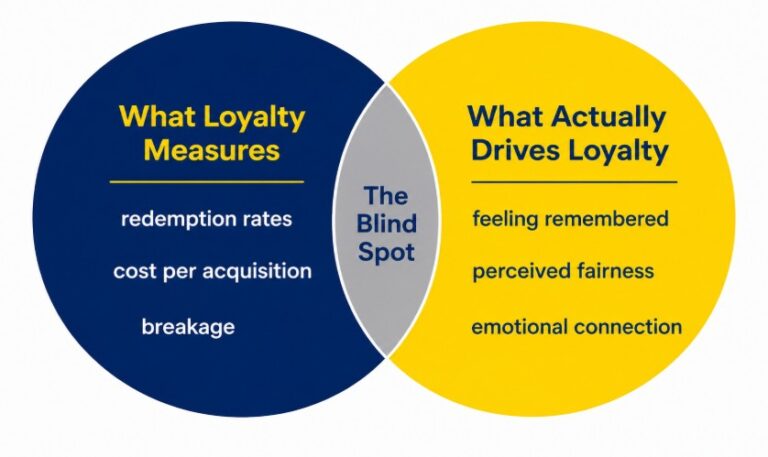
Most loyalty programs are particularly good at measuring what is easy to measure, and quietly bad at protecting what keeps a customer coming back. Redemption rates, breakage, cost per acquisition, and margin per member all get tracked closely. But the metrics that determine whether a customer stays? Those rarely make it onto the dashboard at all.
So why does an industry full of smart, well-intentioned people keep avoiding the one measurement that matters most? Not because anyone decides to ignore it on purpose, but because the thing that actually drives loyalty is harder to measure than what’s currently measured and admitting that means acknowledging that the scorecard everyone already trusts is incomplete. That is an uncomfortable case to make inside any organization, so most programs quietly avoid making it.
This is not a niche problem. It shows up in convenience retail, in CPG, in hospitality, in specialty retail, in nearly every category, just wearing different clothes each time.
How to tell if you have it
There are a few honest signs. If your loyalty team can tell you exactly what last quarter’s redemption rate was but struggles to say what your best customers feel about the brand, that is the blind spot. If every new initiative gets justified with an ROI line but the moments customers talk about most fondly have no ROI line at all, that is the blind spot too.
And if your membership number keeps climbing while engagement, profitability, or plain old member satisfaction quietly flattens, that is often the clearest sign of all. Growth in headcount can mask a real decline in relationship quality, and the data usually looks fine right up until it doesn’t.
Whether the customer feels remembered, treated fairly, or genuinely cared for gets tracked barely at all. The gap between those two things is where most loyalty strategies quietly succeed or fail
Another test: when loyalty has to fight for a seat at the table during commercial planning, ask why. Often it is because the program has only ever been able to speak the language finance already understands, margin, cost, breakage, and has never built the case for itself in the language of relationship. A program that can only justify itself in P&L terms will always lose ground to whichever initiative makes a louder P&L case that quarter.
How to address it
The fix is not abandoning the numbers. It refuses to let them be the only numbers. That means deliberately building moments into a program that have no clean attribution line but clearly shape whether someone stays. It means treating customer data as something that earns trust, not just something that gets monetized for media or targeting. And it means giving the qualitative, emotional side of the program an actual seat in planning conversations, not just a slide at the end of the deck.
Practically, this often starts with sequencing. Tech stack overhauls, new personalization tools, and AI-driven decisioning all promise to close this gap, but only if they are sequenced around a clear goal rather than bought as a wish list. The wrong order, prioritizing flashy new capabilities before fixing core data quality, just produces a more sophisticated version of the same blind spot.
Who is doing this well?
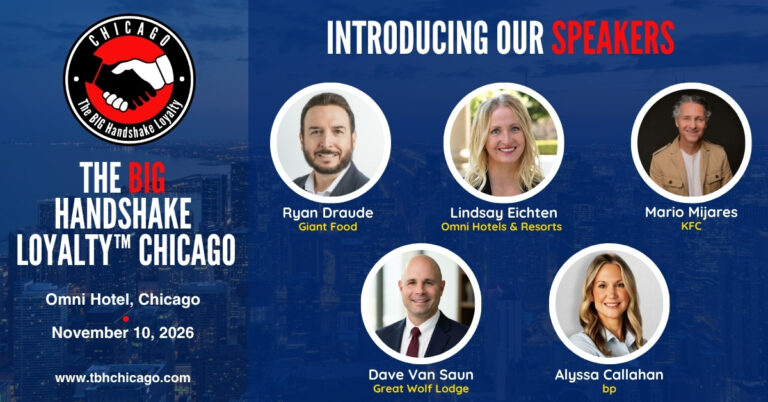
At the inaugural BIG Handshake Loyalty™ event taking place in Chicago this year in November, a few speakers will be addressing this.
Great Wolf Lodge’s Dave Van Saun built the Voyagers Club program around a brutal constraint: most families visit once or twice a year. There is no frequency playbook for that. Instead, the program leans on gamification and emotional anticipation between visits, and it has grown to nearly five million members with an 18 percent lift in repeat visits because of it. That is a program designed for the customer’s experience first, with the business case following.
KFC’s Mario Mijares makes the sharpest version of the argument: a corner store owner a hundred years ago did not need a loyalty program to know which customers needed credit until payday. They just paid attention. His point is not nostalgia; it is a challenge to ask whether today’s programs have actually gotten closer to customers or just gotten better at measuring them from a distance.
And BP’s Alyssa Callahan speaks directly to why this matters at the leadership level. When data strategy quietly shifts a program’s purpose toward monetization, the program can stay fully intact on paper while the actual relationship erodes underneath it. She argues that loyalty earns its seat at the table by protecting that relationship deliberately, not by waiting to be invited.
These three speakers, working in hospitality, QSR, and energy retail, are independently circling the same idea from different angles. That is usually the clearest sign an industry has found something true.
The blind spot does not fix itself. Every quarter that passes without measuring the relationship side of loyalty is another quarter of decisions made on an incomplete scorecard, optimizing for numbers that are easy to defend while the thing that actually keeps customers coming back goes uncounted. The industry knows it. Most programs just have not figured out how to fix it yet.
That is exactly the conversation happening at TBH Loyalty Chicago on November 10. Here is what makes it different from every other loyalty event on your calendar:
Real stories, not highlight reels. TBH speakers share the behind-the-scenes reality of building and running loyalty programs, the pivots, the missteps, the decisions that looked wrong before they looked right. It is vulnerable, human, and refreshingly free of humble bragging.
A room that feels like a community. TBH is deliberately kept intimate and welcoming. The loyalty industry is smaller than it looks, and the relationships built in a room like this tend to last well beyond the day itself.
80% brands, 20% sponsors, and that ratio is intentional. Sponsors at TBH are invited to contribute knowledge and expertise, not to work the room. That means the conversations stay practitioner-led, and the agenda stays honest.
Reserve your seat at TBH Loyalty Chicago