Coinciding with the Olympic Games kickoff on Feb. 6, Intuit launched phase two of its QuickBooks “Outdo” marketing campaign promoting the product’s AI insights and intelligence for small business owners.
The new 30-second spot stars an overwhelmed tooth fairy — recognizable to all as a “small business owner” — who counts children and toothless hockey players as clients. Following a temporary retreat from her duties, she uses QuickBooks’ simple AI interface and business assistance to solve her accounting problems. Olympic tie-ins with the spot include cameos from two-time Gold medalist snowboarder Jamie Anderson and Olympic hockey player Brady Tkachuk, as well as promotion from soccer medalist Alex Morgan.
We spoke with Intuit CMO Thomas Ranese about the QuickBooks campaign, marketplace competition, appealing to younger consumers, lessons gleaned from previous marketing gigs and his thoughts on leadership. (Check out part one here, which covered the company’s growth strategy, platform positioning and approach to AI.)
Chief Marketer: How are your brands setting themselves apart from competitors?
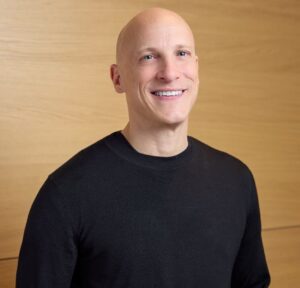
Thomas Ranese, CMO at Intuit: There are two things. One is show the benefits. This is about putting money in people’s pockets. So the more that we can demonstrate the real applications of AI and how it’s delivering true benefits — whether that’s our accounting agent saving customers 12 hours a month or our payments agent helping businesses get paid five days faster — we can show them that we’re not just talking about AI, we’re actually demonstrating how it delivers real tangible benefits. That’s ultimately what our customers need and want. And that’s how we differentiate, full stop.
Second, we are the only real platform that is helping businesses run end to end from lead to cash. A lot of our competitors are promising these end-to-end solutions, but we’re actually doing it and bringing together the power of QuickBooks and MailChimp so that it’s everything from customer acquisition and CRM to payrolls and payments. And that’s actually helping you connect the dots across your business, across your data, and across all the different tools you have to make it seamless and easy to actually drive better results.
The last thing is, bringing AI and HI together is a unique differentiator for us, and having cutting-edge advanced technology that we’ve invested in with a domain expertise and data of the business that we have been a leader on for 40 years. But combining that with a network of 13,000 professionals or human experts who can deliver everything from tax advice to financial consulting, that helped close the loop where technology can solve all the problems.
CM: Tying into that: What are the biggest marketing challenges you’re facing within your category right now?
TR: This is where it comes down to shifting from the hype — the AI-washing — to showing the utility. Everyone now is talking about AI. You drive on the 101 and every billboard is literally a billboard about AI. But how are we actually demonstrating the utility? That’s the opportunity, given that our platform is delivering already today. Helping people see that and understand that, to me that’s the category challenge that we have. And breaking through the clutter with that. [That] is why we took our approach to this campaign, which is to help the invisible be visible and show people how this feels like a team at their side — but giving it a human face, both with our agents but also our human experts, so they feel the comfort still.
I think the industry perhaps is over promising on the benefits of AI. And by bringing AI and HI together, we say, look, AI can’t do everything. There are times you need a human to close the loop or provide a certain amount of personalized advice and insight, or just the empathy that gives you the confidence you’ve made the right decision. And we can bring the power of those together. To me, that’s the challenge of the industry and what we’re doing to tackle it.
CM: Moving on to younger generations of consumers … Buyers are younger; small business owners are younger. Are you reaching them in different ways than in previous years?
TR: It’s a great question. And you’re right. There’s a real growth in solo entrepreneurs and creators and the gig economy — something that’s not really new, but younger generations are increasingly part of. Our campaigns are meant to be modern. They’re meant to be social-, digital-first, in addition to taking advantage of linear TV and showing up at cultural moments like the Olympics, where we know lots of people tune in. But a really important part of our strategy is how we tap influencers, because people like to hear from people who can relate to them. And small businesses in particular like hearing from small businesses that they can relate to.
We’ve built this campaign to have a whole range of influencers that can reach different types of small businesses no matter their age — but particularly reaching a younger generation, who we want to see the value of our platform. By influencers we mean everyone from our experts on our platform and how we engage with them through the funnel to micro-influencers, who are actual real small businesses — we feature seven of them in the campaign — to athletes.
We have partnerships not only with the Olympics but with the NFL. We’re tapping some of our NFL partners and then “celebrities” — and I put that in air quotes because we’re not necessarily about big A-list celebrities, but small business celebrities like Daymond John from “Shark Tank,” who has a way of talking to businesses that can inspire them and rally them up, but also be credible to the problems that they’re trying to solve.
CM: You’ve held CMO roles at Chobani and Uber and also spent many years in marketing at Google. What are some lessons learned from those gigs?
TR: To me, particularly being a tech marketer for the last 20 years, product is brand and brand is product. Our products need to solve real customer needs. And that’s what delivers on the brand promise and ultimately creates the affinity for our brand that fuels our business. [It’s] never forgetting that and partnering with our product teams to make sure we’re delivering on those benefits in a way that truly meets our customers’ needs.
The second is in our marketing communications — making sure we’re featuring the benefits of our products front and center. With this newest campaign, Outdo, [it’s] making sure that we’re actually bringing to life the technology as well as the human network so that people can understand what the benefits of our product are — because that’s what’s going to help them get excited about our brand. That’s been one of the core lessons I’ve learned. And what I love about the work, actually, is leaning into the technology and figuring out ways that people can understand and get excited about it.
I’ve been really lucky to have worked on some pretty major platform brands over my career. Whether it was standing up the hardware business at Google and building an entire platform of Google-branded devices for your life, whether it was repositioning Uber to be a mobility and delivery platform during COVID to help people “go anywhere, get anything,” it’s about understanding how you can communicate the power of a platform to connect the points of your life to deliver benefit. And that’s what we’re trying to do with Intuit, is connect all the points of your financial life to help you make better financial decisions every day, and showing the power of that platform.
CM: What is the leadership strategy you’ve honed over the years?
TR: I think of my leadership strategy as three elements, which is to be bold, take action, and bring humanity to our work and our teams. To be bold is doing work that has the courage to stand for its convictions and showing up for the customer. And that’s work I’m excited that we’re doing without Outdo, which is being bold and courageous [about] showing folks how AI and HI comes to life in their businesses.
Taking action: We live in a time that’s at incredible speed. Marketing today is real time and real world. And if you can’t show up in the moment, the moment passes you by. Being able to move fast and take action and encourage teams to do that is the second thing that I love bringing to the work and my leadership.
The third is the humanity — bringing empathy to the way the brands show up. And I think that’s going to be even more important as we move into this era of AI, as AI bulldozes the playing field on what anyone can do. We need to show the humanity, the insight, the heart that brands are bringing to their customers. And I’d love to bring that to the team so that we can bring that to our customers.
CM: Lastly, what is your advice for aspiring CMOs? What skills should they be developing? I know AI is going to be one of them! But what else?
CM: We have to realize that being a CMO and a marketer today means being a technologist. And in many ways AI is a tool, but it’s also a mindset for how we work. And [it’s about] adopting that mindset and bringing that philosophy to our teams, but frankly our own leadership. Because it starts at the top, and if we don’t adopt these tools and change our mindset and behaviors, our teams won’t. Modeling that behavior for our teams is core.
The second, though, is we have to marry AI and HI — and realize that innovation is great, but we need to integrate that with human qualities like empathy and creativity to bring our work to life in a way that touches people and is effective and breaks through.
The third is prioritizing trust as a competitive differentiator. We’ve had a legacy as a brand in the way we manage people’s data and protect it. And that’s going to become an important differentiator as we move forward. Continuing our legacy at Intuit of being a trusted brand, but making sure that we build and restore strength and trust as marketers as we move forward, is going to be an important unlock in this next chapter.